
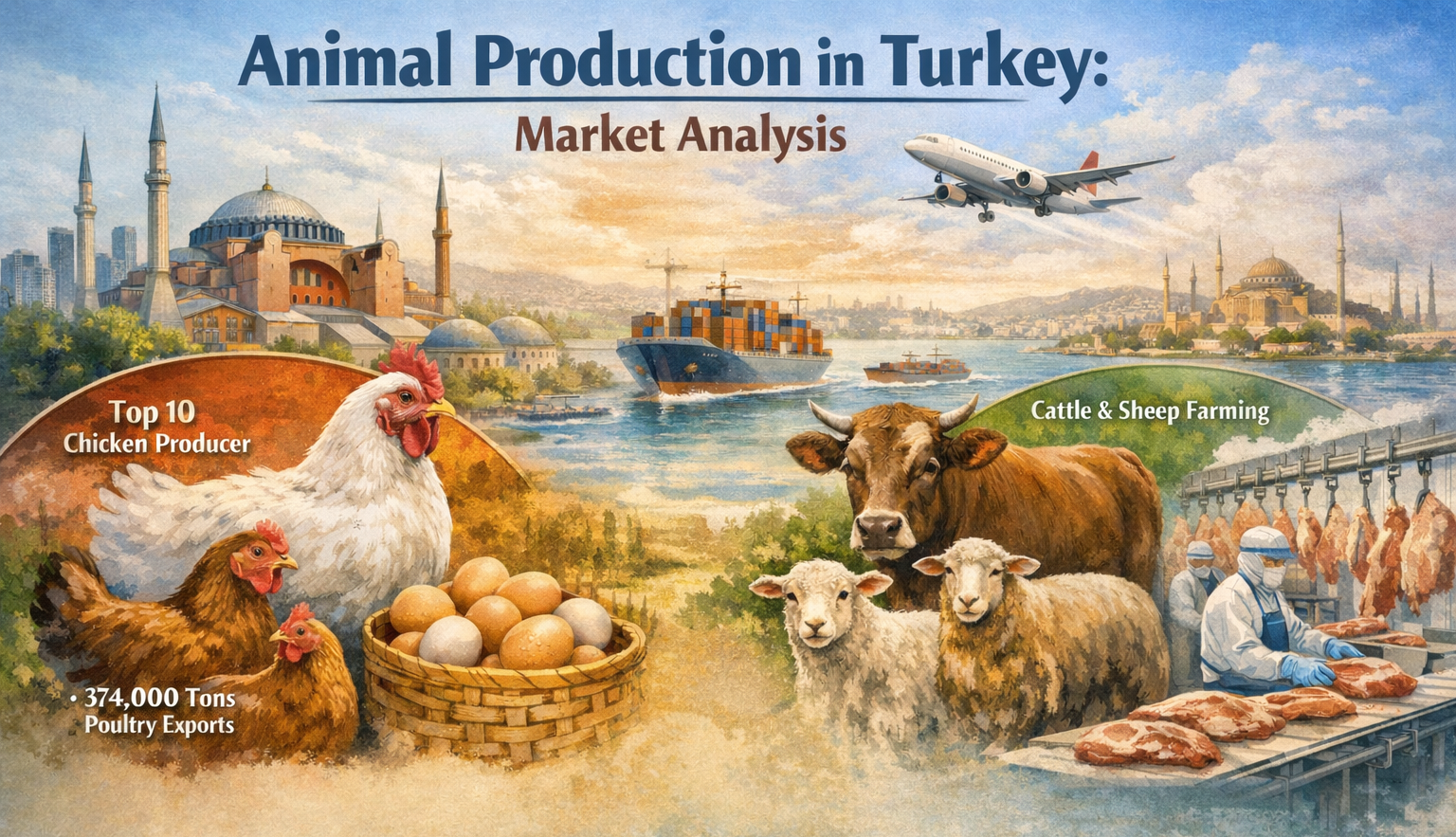
Turkey’s animal production sector isn’t just a pillar of the local food economy—it’s a bellwether for wider trends shaping modern agriculture in Eurasia. From Istanbul’s supermarkets to export routes stretching across the Middle East, understanding animal production in Turkey means grasping both the magnitude and the moving parts of a robust, strategically evolving market.
As strategic consultants, our goal is not to review headlines, but to outline actionable nuance. Below, we dissect the latest data, regulatory dynamics, and operational realities—offering a framework for executives in consumer goods, industrials, tech, and pharma to calibrate supply, forge partnerships, or assess investment opportunities.
—
Overview of Turkey’s Animal Husbandry Sector
Animal husbandry in Turkey is a complex, high-output system in which poultry, cattle, and small ruminants occupy center stage. Statistically, Turkey ranks among the top 10 chicken meat producers globally and is a critical exporter of both poultry and eggs[^1][^2].
The livestock production landscape is equally formidable. Beyond chicken, Turkey’s cattle and sheep herds are among the largest in the region, supplying both the domestic red meat market and neighboring countries.
– Poultry: Over 2.4 million metric tons of chicken meat annually (2024), with further growth predicted[^2].
– Red meat and livestock: Robust domestic production infrastructure supported by advanced feed and veterinary sectors.
– Eggs: Nearly 1.55 billion produced monthly as of February 2025[^3].
This matrix forms the backbone of the Turkish agriculture sector, accounting for a substantial share of national food security and employment.
—
Deep Dive into the Turkish Poultry Market
Turkey’s poultry production is not only a domestic staple—it’s a dynamic export sector. The Turkish poultry market is characterized by strong integration, vertically linked conglomerates, and modernization in processing technologies.
Key data points:
– Production: Turkey is forecast to produce between 2.6 and 2.7 million metric tons of chicken meat in 2025—a record high[^1][^2].
– Consumption: Domestic consumption is expected to reach 2.2 million metric tons in 2025[^2].
– Eggs: Output remains consistently high, providing a reliable export surplus.
– Exports: Poultry exports are anticipated to rise to 374,000 metric tons in 2025[^2], cementing Turkey’s status on tables in the Middle East and CIS states.
Operational metaphor: Think of Turkey’s poultry sector as an advanced logistics hub—the stronger and more adaptive each link (production, processing, export), the higher the throughput and value capture.
For mid-cap executives, the lesson is clear: The Turkish poultry market offers both scale and resilience, essential ingredients for reliable sourcing or B2B partnerships.
—
Livestock and Red Meat Production Statistics
While poultry grabs headlines, livestock production in Turkey—especially cattle and sheep—forms the bedrock of the country’s red meat supply. Cattle production is the primary engine, supported by feedlot operations and an evolving cold chain.
– Beef and veal: Turkey’s cattle herd delivers the largest share of red meat consumed domestically[^4].
– Sheep and goats: Significant in certain regions, anchoring traditional diets and supporting secondary markets (dairy, wool).
– Key numbers: Though detailed current figures require sector-specific access, consistent government incentives and modernizations are increasing output across livestock verticals.
Think of Turkey’s livestock value chain as a three-legged stool: if any component—cattle, sheep, industry support—weakens, the whole system loses balance. Strategic players prioritize diversification or vertical integration to mitigate this risk.
—
Key Drivers and Challenges in Turkish Animal Production
Four forces shape the competitive landscape for animal production in Turkey:
1. Feed and input costs: Like any protein producer, Turkey is sensitive to global commodity price swings, especially for feed grain imports.
2. Disease management: Biosecurity standards are high but require constant vigilance (e.g., avian influenza episodes).
3. Domestic demand: The growing Turkish middle class boosts per capita meat consumption, especially poultry and beef.
4. Policy regulation: Pricing, subsidies, and export controls continue to fluctuate, demanding agility from market participants.
Challenges aren’t distributed equally. Poultry enjoys scale and export reach but faces market access barriers abroad; livestock producers benefit from tradition and regional distribution but are exposed to higher cost volatility.
Mid-sized corporates operating or buying in this space need rigorous scenario planning—the right supplier or investment today could easily face margin pressure tomorrow.
—
Turkey’s Role in Global Poultry and Livestock Exports
Türkiye’s role as a regional export engine cannot be overstated. The country’s poultry exports—projected at 374,000 metric tons in 2025—primarily serve the Middle Eastern and CIS markets[^2]. This resilience in export flows, even with occasional trade disruptions, showcases the adaptability of Turkish producers.
– Eggs: Notably, Turkey is among the world’s top egg exporters[^3].
– Red meat: Exports exist but remain limited by domestic policy and tight inventory balancing. However, limited volumes of live animals and processed meats do reach nearby regions.
For international buyers: Turkey is a “first responder” market, able to ramp supply on short notice. For Turkish producers: export markets provide a critical hedge against domestic downturns.
—
Government Policies and Investment Opportunities
Political influence in animal husbandry in Turkey is omnipresent, shaping everything from farm subsidies to disease outbreak response.
Key policy mechanisms:
– Subsidies for feed, breeding, and modern infrastructure.
– Health regulations aligned with international standards.
– Export controls to prioritize food security but encourage growth in targeted industries.
Investment take-away: The landscape is competitive, but focused investments in technological upgrades, cold chain expansion, and value-added processing hold the greatest return potential. Policymakers are actively courting international capital, especially from companies that bring know-how and supply chain discipline.
—
Future Outlook: Trends Shaping the Turkish Meat Industry
Looking ahead, several secular trends will define animal production in Turkey:
– Digitization: Data-driven traceability and supply chain tech will serve as market differentiators.
– Sustainability: Pressure for greener production and proof of sustainability credentials is intensifying, especially for export-oriented operations.
– Geopolitical dynamics: Turkey’s unique cross-continental position will remain both an asset and a factor to monitor for market access and input sourcing.
A pragmatic framework for 2025–2030: Scale, Adapt, Export. Turkish producers who master efficient scale, rapidly adapt to global trends, and build export resilience will define the sector’s next chapter.
—
Frequently Asked Questions
How large is the poultry industry in Turkey?
Turkey is a top 10 global producer of chicken meat and a major exporter, particularly to the Middle East and CIS countries. The poultry sector is a dominant part of its animal production industry.
What are the main types of livestock in Turkey?
The primary livestock in Turkey are cattle (for both dairy and beef), sheep, and goats. Cattle production is the most significant contributor to the domestic red meat supply.
Is Turkey a major exporter of animal products?
Yes. Turkey is a significant exporter of poultry products, including chicken meat and eggs. It also exports some live animals and red meat, primarily to neighboring regions.
—
Conclusion: Turkey’s Animal Production—Strategic Opportunities for International Growth
Animal production in Turkey represents scale, reliability, and strategic positioning in Eurasian protein markets. Executives weighing supply agreements, investments, or M&A now have a roadmap: anchor in robust poultry markets, leverage livestock diversity, monitor policy evolution, and benchmark against the best-in-class Turkish producers.
Actionable next step:
If animal production in Turkey is (or could be) a node in your value chain, benchmark your current exposure and supply partners against the insights outlined above—then schedule a focused strategy review to convert market intelligence into actionable growth.
—
References
[^1]: [Poultry and Products Annual, Ankara, Türkiye (2025)](https://apps.fas.usda.gov/newgainapi/api/Report/DownloadReportByFileName?fileName=Poultry+and+Products+Annual_Ankara_Turkiye_TU2025-0045.pdf)
[^2]: [Türkiye’s Chicken Production Set for Record 2025](https://feedplanetmagazine.com/blog/turkiyes-chicken-production-set-for-record-2025-4287)
[^3]: [Poultry Production, February 2025, TURKSTAT](https://data.tuik.gov.tr/Bulten/Index?p=Kumes-Hayvanciligi-Uretimi-Subat-2025-53942&dil=2)
[^4]: [Turkey: Poultry and Products Annual, USDA FAS](https://www.fas.usda.gov/data/turkey-poultry-and-products-annual-6
—
Related insights: WUKONG INDUSTRY FOCUS PAGE
Wukong Consulting helps ambitious companies expand with confidence. Our services include:
- Distributor search & shortlisting
- Background checks & credit assessments
- Legal structuring of contracts
- Negotiation coaching & playbooks
- Market entry roadmaps
- Setup of local rep offices or subsidiaries