
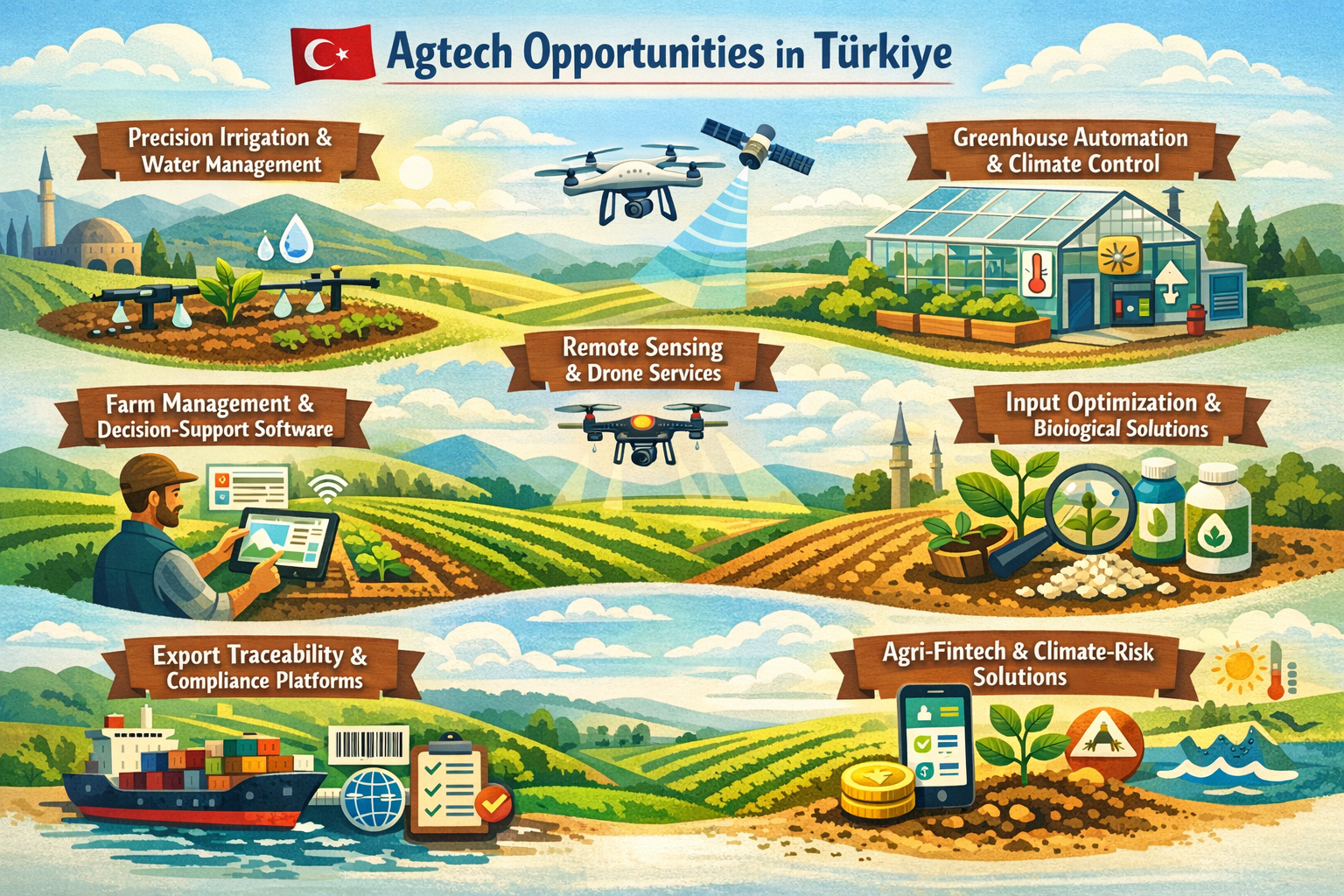
Turkey’s position at the crossroads of Europe and Asia, coupled with vast arable land and diverse climatic regions, has long established its agricultural heritage. But heritage alone won’t secure the sector’s future. As global agricultural value chains digitize and the climate crisis intensifies, the Turkey agritech market is surfacing as an inflection point for investors, technologists, and policymakers alike.
—
Why the Turkish Agriculture Sector is Ripe for Technological Disruption
In strategy, timing and context are everything. Turkey is the seventh-largest agricultural producer globally[^1]. The sector contributes roughly 6% to GDP and employs more than a fifth of the workforce. Yet this economic backbone has long struggled with productivity gaps, fragmented land holdings, water scarcity, and exposure to climate volatility.
Contrast this with Turkey’s demographic dividend—over half the population is under thirty, smartphone penetration exceeds 90%, and digital banking infrastructure is mature. It’s fertile ground not just for crops, but for technology adoption. Traditional pain points—water management, yield volatility, soil degradation—align perfectly with digital solutions ranging from IoT-driven irrigation to data-augmented farm management. The question isn’t ‘if’ disruption happens, but how soon and how deep.
Current State of the Turkey Agritech Market: Size and Growth Projections
Though smaller than its western counterparts, the Turkey agritech market is entering a phase of rapid, compound growth. Precise, up-to-date figures remain underreported, but the Smart Agriculture sector was valued at USD 101.4 million in 2023 and projected to grow at a CAGR of 12.9% through 2030[^1], while Precision Farming is expected to reach USD 197.61 million in 2033 from USD 63.72 million in 2024. This expansion runs parallel with global sectoral tailwinds. By comparison, global agritech is projected to surpass $58.7 billion by 2030, up from $24.4 billion in 2024[^2][^3], evidencing wider investment appetite.
Why this uptick? Broad convergence—rising domestic and export food demand, government digitalization initiatives, increasing venture capital inflows, and an active university R&D scene. A market at this stage is analogous to a field just after tillage—untapped, but ready for high-yield planting with the right seeds: technology and capital.
Key Technology Segments Driving Growth in Turkish Agriculture
For decision-makers, not all digital tools are created equal. Three technology layers account for the lion’s share of current and future impact in the Turkey agritech market:
- Precision Agriculture Turkey: Smart sensors and satellite imagery inform real-time decisions on sowing, fertilizing, and harvesting. Examples include variable rate irrigation and nitrogen mapping, which directly enhance yields and resource efficiency.
- IoT in Turkish Agriculture: Sensors monitor soil moisture, crop vitality, and equipment status, converting farms into data-driven enterprises. This segment is growing at double-digit rates as equipment prices fall and interoperability improves.
- Turkey Agriculture Drones: Drone adoption for aerial surveying, crop disease detection, and targeted spraying is accelerating, driven by favorable regulatory shifts and accessibility to local hardware providers.
Behind these are emerging technologies such as vertical farming, farm management platforms, and biotechnology inputs—each offering distinct avenues for both local differentiation and international competitive advantage.
Spotlight on Leading Agritech Companies and Startups in Turkey
The innovation ecosystem fueling agricultural technology Turkey is both deepening and diversifying:
- Sibernetik: A pioneer in automation and smart farm solutions, targeting data-intensive crop operations[^4].
- Tarfin: Blends agri-finance with digital advisory, offering farmers accessible technology and credit[^4].
- Tarimsal BT: Specializes in farm management software, digitizing crop and livestock tracking for better forecasting[^4].
- GreenBox: Delivers IoT networks that integrate smart irrigation and greenhouse monitoring[^4].
- SoilBiome: Applies biotechnology to optimize soil health, standing out in precision agriculture Turkey[^4].
The competitive landscape is illustrative: agile Turkish startups coexist with established global players testing regional models. Strategic alliances and post-seed funding rounds are increasingly common, further validating market momentum.
Government Incentives and the Investment Landscape
No sustainable market transformation in Turkey occurs without state involvement. Policymakers have introduced a suite of initiatives: tax credits for agri-innovation, grants for digital transformation projects, and ambitious digitalization targets under the Ministry of Agriculture. Smart agriculture Turkey programs—like national pilot projects in digital field mapping—are catalyzing mainstream adoption.
For investors, this landscape presents both subsidy-backed risk mitigation and a spectrum of exits. The entry of global venture funds, paired with rising local angel and family office interest, means more capital is chasing quality assets, particularly in verticals like sustainable farming, biotechnology, and farm fintech.
Challenges and Barriers to Widespread Adoption
Strategic growth always encounters friction. In the Turkish agritech market, a handful of persistent challenges demand frank appraisal:
- Fragmented Land Holdings: Smaller, dispersed farms raise implementation costs for tech solutions.
- Digital Literacy Gaps: While younger farmers engage quickly, generational divides in tech adoption remain.
- Access to Finance: Despite fintech advances, high-tech equipment and software remain capital-intensive for many smallholders.
- Data Interoperability: Competing platform standards and absence of uniform regulation slow integration.
This context calls for what Wukong Consulting terms the “Bridging the Delta” approach: targeted partnerships, modular tech rollouts, and priority investments in training and infrastructure to close the adoption gap without overwhelming end users.
The Future Outlook: Predictions for Agricultural Technology in Turkey
Here’s the strategic forecast. Over the next decade, expect the Turkey agritech market to mature through several inflection points:
- Mainstreaming Precision Agriculture: As costs fall and demonstrable ROI rises, even smallholder farmers will adopt sensor-driven agriculture.
- Scale Up of Smart Greenhouses: Given Turkey’s export edge in produce, controlled-environment agriculture will surge, underpinned by domestic IoT champions.
- Rise of Agrifintech: Platforms that combine product access, crop insurance, and working capital will become standard, powered by stronger data ecosystems.
- Regional Export of Turkish AgriTech Solutions: Once proven domestically, expect Turkish technologies—especially in irrigation and greenhouse systems—to find receptive markets across Central Asia and MENA.
In essence, Turkey is progressing from digital experimenter to digital innovator in agriculture, converting structural challenges into competitive advantage.
Conclusion
The Turkey agritech market stands at a critical juncture. For strategic investors, technology vendors, and agri-enterprises, the window for meaningful market entry and expansion is now—before consolidation sets in and value pools shift. Success will go to those who combine regional fluency with modular, scalable solutions.
Next step: If you’re considering a move into Turkish agricultural technology, Wukong Consulting recommends a structured opportunity scan—mapping supply chain gaps, regulatory incentives, and competitive whitespace. Reach out for a tailored briefing or an in-depth market map.
Frequently Asked Questions
What is driving the growth of the agritech market in Turkey?
Key drivers include government support for digitalization, the need for increased crop yields and efficiency, and a growing ecosystem of tech startups focused on solving agricultural challenges.
Which agritech technologies are most prominent in Turkey?
Precision agriculture technologies like smart irrigation and sensor-based monitoring, IoT devices for data collection, and agricultural drones for crop analysis are the most prominent in Turkey.
Are there opportunities for foreign investment in Turkish agritech?
Yes, the Turkish agritech sector presents significant opportunities for foreign investors, particularly in areas like farm management software, sustainable farming solutions, and agricultural biotechnology.
Related Insights
References
[^1]: [Turkey Agritech Market Size, Share, Analysis – 2032](https://www.sphericalinsights.com/reports/turkey-agritech-market)
[^2]: [AgriTech Market Overview, 2025-2030](https://www.researchandmarkets.com/reports/6190385/agritech-market-overview)
[^3]: [Agritech Industry Analysis: Market Competition and Future Opportunities](https://www.einpresswire.com/article/884774924/agritech-industry-analysis-market-competition-and-future-opportunities)
[^4]: [Companies Profiled in “Turkey Agritech Market Size, Share, Analysis – 2032”](https://www.sphericalinsights.com/reports/turkey-agritech-market)