
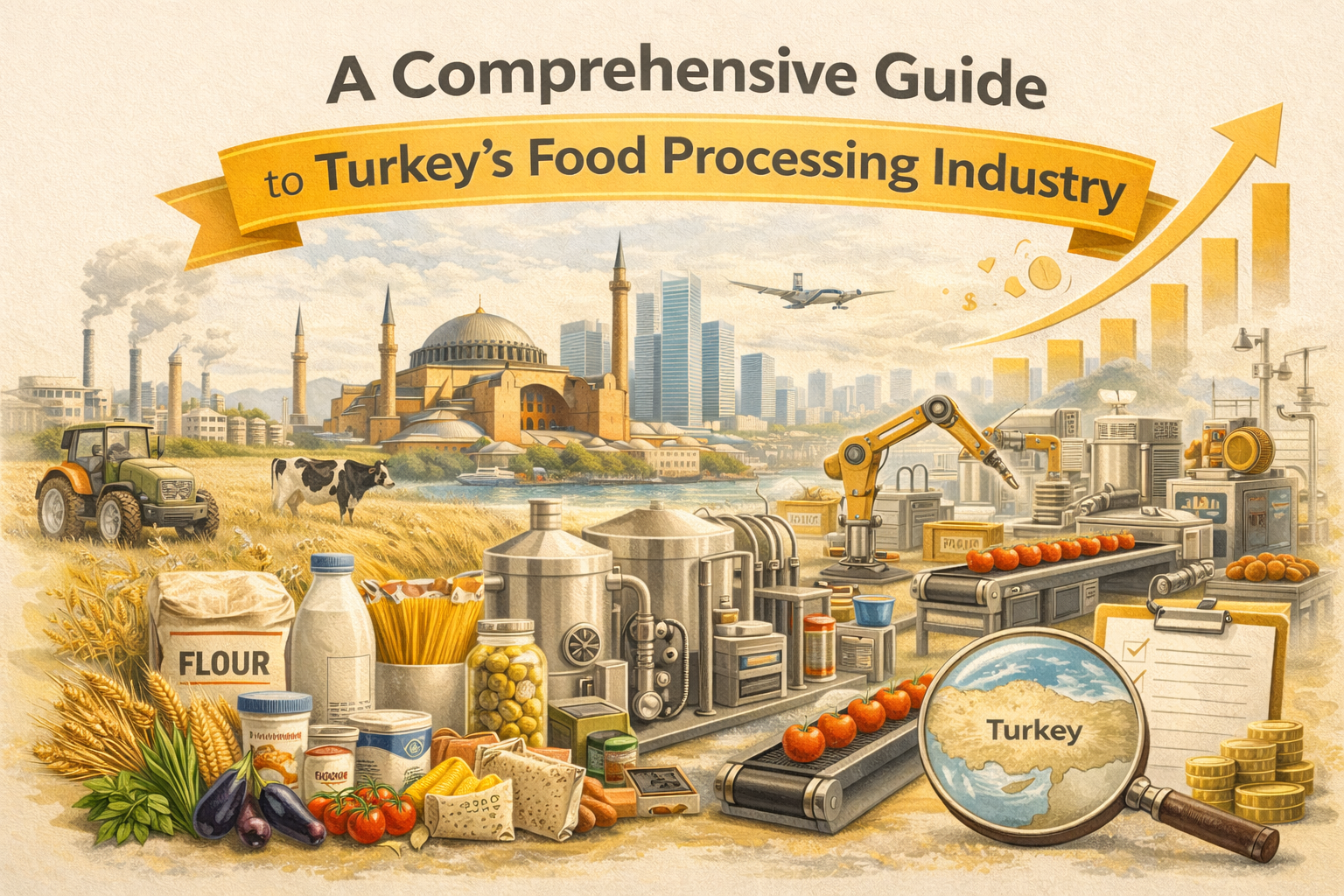
Overview of the Turkish Food Processing Market
Turkey’s food processing industry sits at the center of the nation’s economy—bridging vast agricultural output with domestic and global consumption. With a packaged food market approaching USD 24.6 billion in 2025 and maintaining a robust 5.8% CAGR through 203012, Turkey has become a major regional processing and export hub. The sector spans over 58,000 processing businesses3, contributing significantly to GDP, employment, and national exports. For a broader picture of the Turkish F&B market, see our market overview.
Growth is driven by strong agricultural resources, an expanding consumer class, and favorable trade dynamics. But the scale of the sector also tells a second story: with over 58,000 processing sites competing in a cost-sensitive, inflation-pressured environment, the market is as competitive as it is large. For strategic decision-makers—whether entering as a finished goods exporter, a technology provider, or an investor—understanding both the structural foundations and the friction points is essential for sustainable growth.
Key Segments Driving Food Manufacturing in Türkiye
Mapping the food manufacturing sector Türkiye is like tracing a tree’s roots—each major segment feeds both the domestic plate and the export basket. The top segments propelling growth include:
- Grain Milling and Bakery: Turkey is the world’s largest flour exporter, underpinned by advanced milling technologies and strategic wheat access.
- Pasta and Processed Grains: Turkish pasta is globally competitive, owing to cost-effective inputs and scale production.
- Dairy and Cheese Processing: A sector marked by both modern and traditional techniques, serving EU and Middle Eastern markets.
- Vegetable Oil and Sugar Refining: Built on domestic crops and processing expertise, these segments supply regional and global demand.
- Processed Fruit and Vegetables: With a €13.4 billion market size in 20253, this segment leverages Turkey’s extensive crop diversity and export infrastructure.
Turkey’s processing strength in these categories is inseparable from its agricultural base — for a closer look at the upstream dynamics shaping input availability and cost, see our analysis of Turkey’s Livestock and AgTech sector.
These segments don’t just fulfill basic needs—they respond to nuanced demand in both local and export-facing channels. Turkey combines cost-advantaged agricultural inputs with processing technology, creating competitive advantage across food manufacturing. The flip side: cost competitiveness is structural, meaning buyers will benchmark any solution—technology, ingredients, or equipment—against that same cost discipline.
Emerging Trends and Innovations in Food Processing
To remain competitive, Turkish food processing trends increasingly reflect global shifts in health, technology, and convenience. Three meta-trends merit strategic focus:
- Rising Demand for Convenience and Ready-to-Eat: Urbanization and shifting lifestyles drive consumption of packaged, easy-to-prepare foods. The packaged food segment’s sustained CAGR2 speaks to the rapid mainstreaming of convenience.
- Shift Toward Health, Organic, and Sustainable Products: Health-conscious consumers and export partners are catalyzing product reformulation and the introduction of certified organic lines—now commonplace among food processing companies Turkey.
- Adoption of Automation and Digitalization: An 8.3% CAGR in food and beverage processing equipment (2020-2026)4 highlights accelerating investments in next-generation processing, efficiency monitoring, and traceability platforms. This appetite for technology is genuine—but buyers typically demand fast, demonstrable ROI and expect suppliers to provide robust local service and technical support. Proposals that cannot articulate a clear payback period within the Turkish economic context tend to stall.
Leading firms use these trends as a navigational compass—prioritizing technology upgrades, adapting to regulatory shifts, and targeting high-margin, export-ready innovation.
Investment Opportunities and Government Incentives
Turkey’s food processing industry offers compelling opportunities for foreign and domestic investment. Three principal layers stand out:
- Value-Added Processing: Untapped potential remains in high-margin, innovative segments—functional foods, ready meals, dairy alternatives, and health snacks.
- Technology and Equipment Upgrades: Upgrading to advanced processing lines increases efficiency and unlocks new product formats while ensuring compliance with export requirements.
- Export-Focused Ventures: With access to EU, MENA, and CIS markets, manufacturers with export-readiness can capitalize on currency advantages and robust global demand.
Investment is further encouraged by Turkish government incentives, including customs exemptions, VAT reductions, tax benefits, and R&D support—targeted especially at technology adoption, employment, and regional development5. In practice, however, navigating this incentive landscape requires careful planning: the framework is layered, eligibility criteria vary by region and investment size, and localization requirements can add complexity for international players. Building the incentive case into a business plan is worthwhile—but it should be stress-tested rather than assumed.
Leading Food Processing Companies in Turkey
A clear look at food processing companies Turkey reveals a blend of homegrown giants and international entrants:
- Ülker, TAT, Pınar, Dardanel: Domestic champions with deep distribution networks, brand loyalty, and hard-won retail relationships that international entrants will need to reckon with.
- Anadolu Efes, Sütaş, Torku: Vertically integrated players combining agricultural supply, processing scale, and national logistics reach.
- International players (Nestlé, Danone, PepsiCo, Coca-Cola): Operating locally with highly adapted strategies and significant local sourcing—proof that success in this market requires genuine localization, not just market presence.
The lesson: competitive positioning now requires not only supply chain depth but also innovation in distribution, digital delivery, and consumer engagement. For foreign entrants, competing directly with established domestic players on price or distribution breadth is rarely a winning strategy—differentiation on technology, quality, or category creation is the more defensible path.
Navigating the Regulatory Landscape and Challenges
The regulatory environment in the Turkish food processing industry is dynamic and highly relevant for investors:
- Compliance with Local and International Standards: Turkey aligns much of its food safety and labeling regulations with the EU, but strategic divergence remains. Regular updates and sector-specific guidelines are the rule, not the exception.
- Traceability and Transparency Requirements: The drive toward broader traceability, especially for export, is prompting significant investment in digital solutions—and creating a compliance-driven demand that comes with heavy documentation requirements on both buyers and technology vendors.
- Input Cost Volatility and Currency Fluctuation: Turkey’s agricultural base is a genuine strength, but exposure to input price volatility and TRY depreciation poses real risk to unhedged operators. For technology and equipment suppliers, this also translates into financing and payment risk—deals that look commercially attractive in EUR or USD can become strained when buyers are managing in a depreciating local currency.
- Intense Price Competition: With over 58,000 processors operating in a cost-sensitive environment, price competition is structural. Technology and ingredient vendors will encounter short ROI expectations and well-informed procurement teams that benchmark aggressively.
- Distribution and Logistics Complexity: As Istanbul-centric supply gives way to a more diversified footprint, logistics sophistication and cold chain management become mission-critical.
Navigating these challenges requires not just compliance but proactive risk management, local context awareness, and continuous investment in adaptive capabilities.
Future Outlook for Turkey’s Agribusiness Processing Sector
The future of Turkey agribusiness processing will be defined by convergence: technology, consumer preferences, sustainability, and regulatory harmonization. Here’s the distilled outlook:
- Continued Export Growth: Favorable trade agreements, proximity to high-growth markets, and scale efficiencies will sustain export expansion.
- Innovation in High-Value Segments: Firms investing in plant-based, fortified, or convenience foods will capture greater market share and price premiums.
- Green Processing and Sustainability: ESG and sustainability become not just compliance levers but drivers of consumer preference and international partnership eligibility.
- Resilience through Agro-Tech: The integration of digital, automated, and AI-enabled systems into agro-processing will separate resilient, future-ready firms from the pack—but the transition will be gradual and uneven across a sector that still includes a large tail of smaller, less capitalized processors.
In sum, the food processing industry Turkey embodies a textbook case for competitive adaptation—where those who combine scale, agility, and innovation will define the market’s next epoch. The opportunity is broad-based and real. Realizing it, however, rewards those who engage with the market’s complexity rather than around it.
This article maps the structural landscape. Our Sector Focus goes further — identifying the specific processing clusters, key buyers, and the commercial constraints that matter most for technology and ingredient providers assessing this market. Request your copy below
Take Action: Now is the time for strategic stakeholders to reassess their approach in Turkey’s food processing sector. Consider an audit of your market positioning, innovation readiness, and export capabilities—leverage Wukong Consulting’s regional expertise for a tailored roadmap to sustainable, cross-border growth.
Frequently Asked Questions
How big is the food processing industry in Turkey? The food and beverage industry is one of Turkey’s largest manufacturing sectors, contributing approximately 15% of total manufacturing output value, with over 58,000 processing sites and strong export orientation.
What are the main food products processed in Türkiye? Key processed products include flour, pasta, vegetable oils, sugar, dairy products, and processed fruits and vegetables, leveraging the country’s rich agricultural output.
What are the key trends in the Turkish food processing sector? Major trends include growing demand for convenience and ready-to-eat meals, increasing focus on organic and healthy products, and the adoption of automation and digitalization—though uptake is uneven and driven heavily by export competitiveness requirements.
Are there foreign investment opportunities in Turkey’s food sector? Yes, the sector offers significant opportunities for foreign investors, particularly in value-added products, technology upgrades, and export-focused ventures, supported by government incentives. Success requires navigating a complex localization and compliance framework alongside the commercial opportunity.