
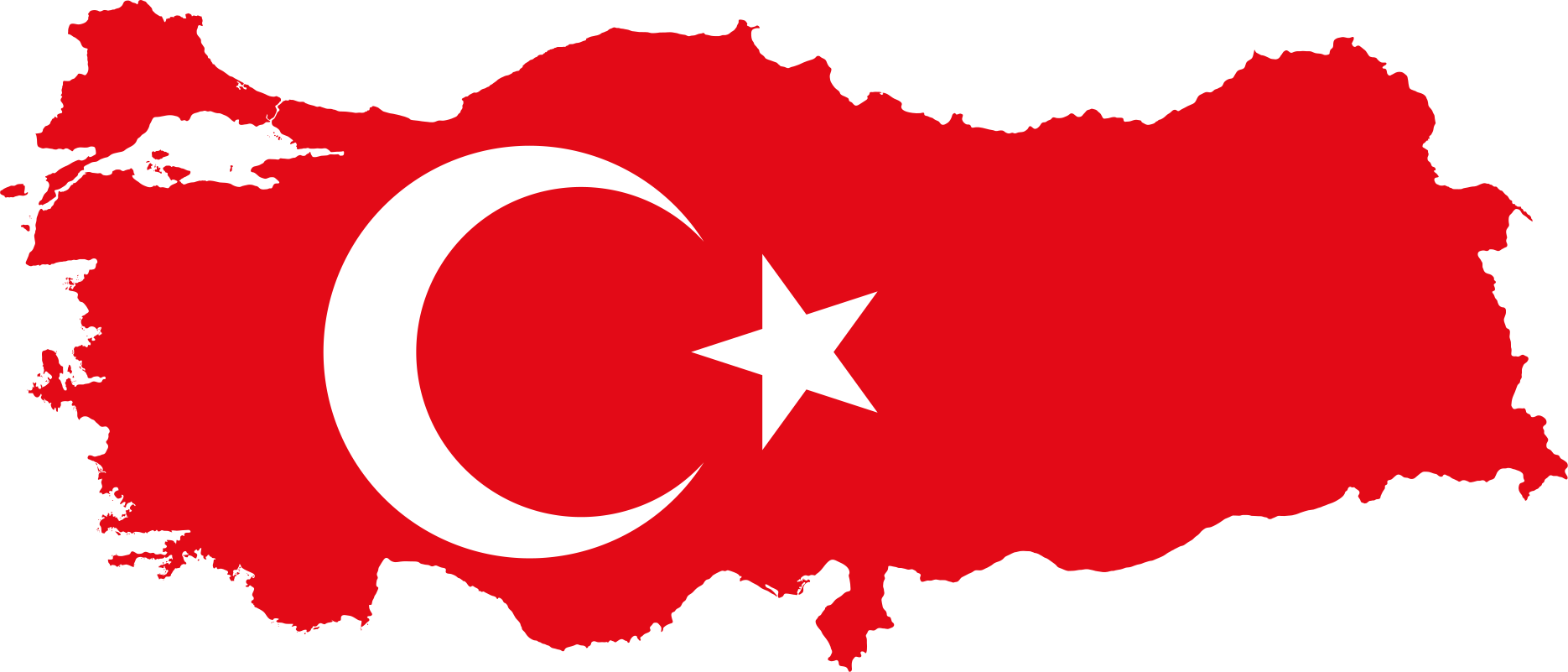
Türkiye is no longer a frontier market footnote. It is the world’s 12th largest economy by purchasing power parity, and by 2026 the OECD projects it will break into the top 10. By 2052, the same projections place it 5th globally, ahead of Germany, the UK, and most of the economies European executives grew up treating as benchmarks.
That trajectory is not an accident. Since 2002, Turkish GDP has grown from $238 billion to $1,596 billion (a 6.7-fold increase in 23 years) at an average annual real growth rate of 5.3%, consistently outpacing Poland, Romania, Bulgaria, Czechia, and Hungary. Gross public debt stands at 22.8% of GDP, against an EU27 average of 82.5% and a Maastricht limit of 60%. The country has met the EU’s 60% public debt criterion every year since 2004.
European companies that have already moved (and there are now 86,900 international companies operating in Türkiye, up from 5,600 in 2002) know something that those still watching from Brussels or Paris have not fully priced in: this market rewards those who arrive with a real plan and penalises those who arrive late.
Why Türkiye? The Economic Case in Numbers
The numbers are worth stating plainly, because the perception gap between Türkiye’s actual performance and its reputation in boardrooms remains wide.
GDP per capita in purchasing power parity terms has grown fourfold since 2002, from $10,988 to $40,501, generating a substantial middle class with real purchasing power. The stock of automobiles has grown from 4.6 million to 17.4 million. Domestic aviation passengers have grown from 34 million annually to 247 million. These are not emerging-market indicators. These are the consumption numbers of a large, sophisticated domestic economy.
FDI tells the same story. Between 1973 and 2002 (29 years) Türkiye attracted $15 billion in cumulative foreign direct investment. Between 2003 and 2025 (22 years) it attracted $288 billion. The multiplier is not gradual improvement. It is structural transformation.
For European companies, the labour cost equation is also compelling. The mandatory minimum wage in 2026 is TRY 28,075.50 net per month (approximately €527) in a market where the workforce has a median age of 34.9 and 68% of the population is of working age. Wage competitiveness, scale, and a young talent pool are rarely available in the same package.
Strategic Location and Market Access
Türkiye’s geography is its second economic asset. Positioned at the intersection of Europe, Asia, and the Middle East, it provides operational access to markets that European companies typically address through separate regional strategies.
Working hours in Istanbul overlap with 16 time zones. Turkish Airlines serves 356 destinations in 132 countries, more destinations than any other airline in the world. Istanbul Atatürk and Istanbul Airport together handle hundreds of millions of passengers annually and connect to the nearest major markets within 4 hours.
The trade architecture reinforces the geographic advantage. Türkiye operates inside a Customs Union with the EU, meaning goods manufactured in Türkiye face zero tariffs on export to 450 million EU consumers. Beyond that, free trade agreements with 30 additional countries create access to a further 488 million consumers. Total addressable market from a Turkish manufacturing or logistics base: over 1 billion consumers with no tariff barrier.
For European companies looking to serve MENA, Central Asia, and the Caucasus from a single operational base, Türkiye removes the structural cost of running separate regional operations.
Key Sectors for European Investment
Not every sector carries the same opportunity profile. Based on current FDI data and market dynamics, five sectors merit European attention in 2025.
Manufacturing and export-oriented industry remains the backbone of Turkish FDI. Türkiye has established itself as a European production base for automotive, machinery, chemicals, and white goods, with many multinationals exporting 75–87% of their Turkish production output. Labour cost competitiveness plus Customs Union access has made this the default rationale for manufacturing investment.
Technology and ICT represents the fastest-growing opportunity. Türkiye’s ICT market stands at $36.7 billion. The startup ecosystem is the most active in the region, with a growing number of unicorns and strong engineering talent emerging from technical universities. European tech companies looking for scalable R&D capacity at competitive cost should be looking at Istanbul, Ankara, and Izmir.
Energy and renewables is a structural play. Türkiye has reached 58% installed capacity from renewable sources and is investing heavily in wind, solar, and green hydrogen. The energy transition agenda, combined with the country’s own manufacturing base for solar panels and turbines, creates both infrastructure investment opportunities and supply chain positioning.
Healthcare and pharmaceuticals sees strong domestic demand driven by a growing middle class and an ageing population in urban centres. Türkiye has 24 cities with populations over one million, each representing a substantial healthcare market. EU-standard regulatory alignment in pharma creates a relatively familiar compliance landscape.
Real estate and logistics infrastructure completes the picture, driven by the same demographic and trade volumes that make the other sectors interesting. Türkiye is building at scale, and European developers, logistics operators, and infrastructure investors have entered the market.
How to Set Up a Company in Türkiye
The mechanics of establishment are more straightforward than the market’s reputation suggests. The standard process takes 8 days. The main legal forms available to foreign investors are:
A Joint Stock Company (Anonim Şirket, AŞ) is the standard vehicle for larger operations and those seeking to access capital markets. It can be incorporated with a single shareholder (no upper limit on shareholder count), managed by a board of directors of at least one member appointed for up to three-year terms. Shareholders are not personally liable for corporate debts.
A Limited Liability Company (Limited Şirket, Ltd. Şti.) is the most common structure for smaller or mid-sized operations. It allows 1 to 50 shareholders of any nationality, and must be managed by at least one manager who is also a shareholder. This is often the first vehicle for European SMEs entering the market.
A Branch Office can be established without government consent (except in regulated sectors) and requires a Turkish-resident national representative with a local tax identification number. It is not a separate legal entity. Obligations flow through to the parent.
A Liaison Office is useful for market intelligence and business development but is restricted: it cannot generate commercial activity or revenue in Türkiye. It requires prior written consent from the Ministry of Industry and Technology.
Under FDI Law No. 4875 (2003), foreign investors receive equal treatment with domestic investors. 100% foreign ownership is permitted, with limited exceptions for strategic sectors. Proceeds can be freely repatriated. No minimum capital is required for Limited Liability Companies beyond the nominal amounts specified by law.
Investment Incentives and Tax Advantages
Türkiye’s investment incentive system is one of the most comprehensive in the region, structured across four main schemes: the General Investment Incentive Scheme, the Regional Investment Incentive Scheme, the Priority Investment Incentive Scheme, and the Strategic Investment Incentive Scheme.
Incentives vary by investment zone and sector, but the standard package can include: customs duty exemptions, VAT exemptions, corporate tax reductions, social security premium support, interest or profit share support, land allocation, and in certain zones, income tax withholding support.
The double taxation treaty network covers 93 countries. One of the broadest in the world. This substantially reduces the cost of moving profits, royalties, and dividends between Turkey operations and European headquarters. For EU-based companies, this means that repatriation of returns is both legally straightforward and tax-efficient.
Free Zones (of which Türkiye has 21) offer additional advantages for export-oriented operations: corporate tax exemption on export income, VAT exemption, customs duty exemption, and social security incentives. They function as duty-free manufacturing and logistics hubs with full access to the EU through the Customs Union.
Understanding the Business Culture
Türkiye is a relationship-driven market. This is not a cultural note to acknowledge and ignore. It is the operating variable that most consistently determines whether European companies succeed or fail in their first 18 months.
Decision-making concentrates at the top. In Turkish SMEs and family-owned businesses, which represent the majority of potential partners and customers, the CEO or majority shareholder is the effective decision-maker. Access to that person matters more than the quality of the pitch deck.
Trust is built in person. Introductions through established networks (chambers of commerce, institutional partners, or existing business relationships) accelerate timelines that would otherwise take years. Cold outreach without a warm introduction is treated with appropriate scepticism.
Negotiation is a process, not an event. Turkish counterparts typically expect multiple rounds of conversation before committing to terms. Rushing the relationship-building phase to get to the commercial conversation faster is the most common mistake European executives make. The meeting is the work.
Language is often underestimated. English is widely spoken in Istanbul business circles and large multinationals. Outside the major metropolitan areas, or in negotiations with family-owned Turkish companies, Turkish-language capacity (or a trusted interpreter) is not optional.
Practical Steps: From Idea to Market Entry
A structured market entry process for Türkiye should cover five dimensions, in sequence.
First, readiness assessment. Most companies that fail in Türkiye did not fail because of the market. They failed because they were not ready for the market. This means product-market fit validation, pricing model review against Turkish income realities, and an honest assessment of competitive positioning against both local players and established foreign operators.
Second, market intelligence. You need to know who the customers are, who the partners are, who the competitors are, and what the regulatory environment looks like for your specific product or service. Generic market reports are not a substitute for primary research.
Third, legal structure selection. The right vehicle depends on the commercial model, the timeline, and the risk appetite of the parent company. Getting this wrong creates restructuring costs later.
Fourth, partner or distributor identification. Most European companies enter Türkiye through a commercial partnership before establishing a direct presence. Partner selection is the single most consequential early decision. The wrong partner can close doors that are difficult to reopen.
Fifth, operational setup. This includes banking, employment, accounting, and compliance, the infrastructure that makes everything else function. It is less glamorous than market strategy but it is where deals die after they are won.
The Wukong Perspective: What Most Guides Don’t Tell You
Most guides to investing in Türkiye stop at the opportunity case. Türkiye is big, growing, young, and well-located. True. Not sufficient.
What the data doesn’t tell you is that Türkiye rewards patient entry and punishes rushed entry. Companies that arrive with a three-month timeline and a signed distributor agreement routinely discover, six months later, that the distributor is managing ten other brands and giving theirs minimal attention. The market looks accessible until you are in it and discover the density of local competition that doesn’t appear in market research reports.
Currency volatility is real and must be planned for structurally, not reactively. Contracts denominated in Turkish lira require hedging mechanisms that most European SMEs have not built. This is not a reason to stay out, it is a reason to structure the entry correctly.
The regulatory environment has improved significantly since 2003 but is not static. Laws and implementation details change, and what is standard practice in one sector may be restricted in another. Local legal counsel is not optional. It is the minimum operating cost of doing business correctly.
And finally: the relationship capital you build in Türkiye compounds. The executives who have been operating there for five years are not playing the same game as those arriving for the first time. The right partners (people who know who to call, which doors to open, and when to wait) are the most durable competitive advantage available to a European company entering this market.
Conclusion
Türkiye in 2026 is not a market to monitor. It is a market to decide about. The growth trajectory, the demographic profile, the trade architecture, and the competitive window, these are not permanent. Companies that move with preparation now will be building from a position of established relationships and operational experience. Those who wait for the geopolitical noise to clear will be arriving late, into a market that has already sorted its foreign players.
The case for entry is strong. The case for doing it right is stronger.
Wukong Consulting supports European companies at every stage of market entry into Türkiye : from readiness assessment through partner sourcing, legal setup, and on-the-ground execution.
Contact us to discuss your specific situation.
Sources & Further Reading
– Türkiye Investment Office : Presidency of the Republic of Türkiye
– Investment Incentives in Türkiye : Türkiye Investment Office
– Free Zones in Türkiye : Türkiye Investment Office
– Company Setup Guide : Türkiye Investment Office
– OECD Economic Outlook : Türkiye : OECD
– Turkish Statistical Institute (TurkStat) : Official national statistics
– Ministry of Trade: Customs Union and FTA framework
– Turkish Airlines : Global network data
– Trade Registry System (MERSIS) : Company registration portal