
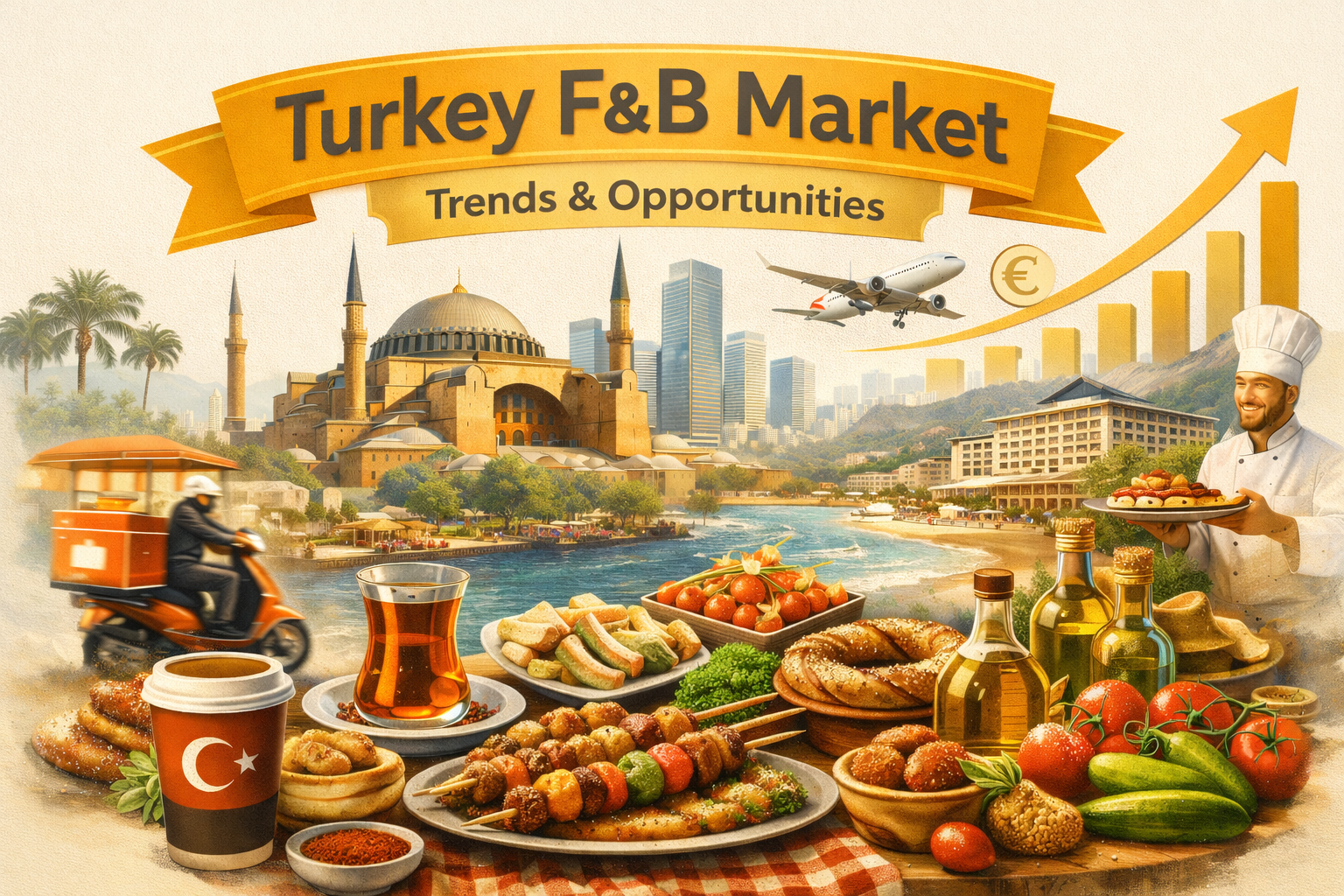
The Turkish Food and Beverage Market at a Glance
The Turkey F&B market has reached an inflection point. Robust domestic demand, accelerating urbanization, and record-breaking tourism have transformed the sector into a regional powerhouse worth billions. For mid-cap businesses in consumer goods, industrials, tech, and pharma, this isn’t just an export story—it’s a masterclass in market reinvention, scale, and cultural nuance. Over the next decade, the Turkey food and beverage market is forecast to nearly double in value, driven by shifting consumption patterns and a dynamic foodservice sector12.
The opportunity is substantial—but it is also selective. For international players, the addressable market is more concentrated than headline figures suggest: affluent urban districts and tourism-driven hubs are where demand for foreign products is genuine and scalable. Realizing the opportunity demands a clear grasp of key trends, regulatory complexity, and the divergent needs of local versus international consumers. This analysis distills hard data, real-world examples, and actionable insight to equip leaders for growth in a market that rewards precision and adaptability in equal measure.
Market Size, Growth Projections, and Key Segments
A Multi-Billion Dollar Force—With Important Caveats
The Turkey F&B market ranks among the largest in the EMEA region. In 2025, the Turkey foodservice market alone will reach USD 43.9 billion, with projections climbing to USD 97.7 billion by 203412. This 13.5% compound annual growth rate stems from three structural engines:
- Demographics: 85 million consumers, median age under 32
- Tourism: 60.4 million foreign arrivals in 2024, 70.5% hotel occupancy, and a target of 90 million annual visitors by 20282
- Export Orientation: Turkish F&B brands and ingredients now reach across the Middle East, Europe, and beyond
A necessary qualifier: a significant portion of Turkey’s nominal revenue growth is inflation-driven rather than reflecting real volume expansion. The Turkish lira’s sustained depreciation means USD-denominated figures can flatter the underlying picture. Investors and exporters should benchmark performance in volume terms and real purchasing power, not only top-line USD revenue.
Key Segments at the Forefront
- Quick Service Restaurants (QSR): Commanding 60%+ market share, led by chains like TAB Gıda and DP Eurasia2
- Food Delivery: Digital platforms such as Yemeksepeti and Getir Yemek are driving double-digit annual volume growth in both urban centers and secondary cities
- Traditional Turkish Cuisine: Simit Sarayı and similar homegrown concepts blend street food appeal with scalable chain formats
- Beverages: Starbucks Turkey’s tailored locations and an evolving specialty coffee scene signal a pivot toward premiumization and global tastes
Dominant Turkey Food Market Trends Shaping the Industry
The Health-Conscious Consumer Has Arrived—in Select Pockets
Turkish buyers increasingly demand transparency, cleaner labels, and functional benefits. Data from Innova Market Insights shows surging interest in plant-based, high-protein, and “better-for-you” snacks and drinks since 20223. However, this trend is concentrated among higher-income urban consumers—primarily in Istanbul, Ankara, İzmir, and coastal tourism hubs. For international players, this means the addressable segment for premium health-oriented products is real, but nationally limited. Scaling beyond these clusters requires a different product and price architecture entirely.
McDonald’s Turkey, for instance, sources 95% of ingredients locally and offers Turkey-specific menu items—a localization strategy that has driven market share gains against entrenched local brands.
Plant-Based and Sustainable Sourcing
Traditional proteins remain staples, but interest in plant-based alternatives has moved well beyond niche. Meat analogs, oat milk, and sustainable seafood now appear on mainstream retail shelves and QSR menus. Startups and mid-level manufacturers gain an edge through partnerships with local producers—speed to market and local authenticity consistently outpace imported-only solutions3.
Convenience Drives Format Innovation
Time-strapped urban households are reshaping retail and dining. Ready-to-eat meals, grab-and-go bakery options, and multichannel delivery dominate Istanbul and Ankara metros. This trend creates value for both domestic and international producers agile enough to partner with fast-evolving foodservice and delivery ecosystems.
Deep Dive: Turkey Beverage Market Analysis and Drivers
Coffee, Tea, and an Emerging Non-Alcoholic Segment
If food mirrors culture, beverages in Turkey reflect both tradition and transformation. Tea remains the national beverage, but specialty coffee chains—like Starbucks Turkey, with 685 outlets and innovative café formats—demonstrate Turkish consumers’ willingness to embrace global trends alongside local rituals.
Non-Alcoholic Growth Outpaces Alcoholic Beverages
A young population, religious preferences, and urbanization have fueled exceptional growth in non-alcoholic offerings: cold brew, sparkling flavored water, kombucha, and functional drinks. Distribution partnerships and product localization prove crucial—global formulas rarely win without adaptation.
Innovation in Packaging and Channel
Sustainable packaging and single-serve formats gain traction amid regulatory tailwinds aimed at waste reduction. Success stories in the Turkey beverage market analysis almost always feature nimble supply chains and localized marketing, not just product R&D.
The Dynamic Turkey Foodservice Market: HORECA and Delivery
HoReCa: Fastest-Growing Channel
Hotels, restaurants, and cafés (HORECA) sit at the heart of the Turkey foodservice market’s explosive growth. Urban renewal, hospitality investments, and surging tourist arrivals in hubs like Antalya and Istanbul underpin strong demand. In 2024 alone, Antalya welcomed 17 million tourists, and hotel F&B operations have grown increasingly sophisticated2.
Digital Expansion: Delivery and Cloud Kitchens
Rapid adoption of food delivery has reshaped urban dining in Turkey. Third-party apps (Yemeksepeti, Getir Yemek) and the proliferation of cloud kitchens are altering the competitive landscape—a dynamic where mid-cap operators, not only global giants, can carve out defensible positions with the right tech and local understanding.
Success Stories: Adaptation Wins
TAB Gıda’s expansion—spanning Burger King to local favorites like Usta Dönerci—demonstrates how localized offerings, scale, and logistics management trump one-size-fits-all strategies. DP Eurasia leverages digital-first delivery to extend Domino’s reach in the pizza segment. These case studies serve as practical blueprints.
Investment Opportunities in the F&B Industry Turkey
Hotspots for Capital and Growth
For investors and mid-cap entrants, the F&B industry Turkey offers:
- QSR and Fast Casual Rollouts: Emerging middle-class neighborhoods, tier-two cities, and shopping centers remain underserved by modern chains
- Plant-Based and Health-Focused Manufacturing: Rapidly rising demand creates space for both local innovation and international JV/technology transfer
- Foodservice Technology: Ordering, logistics, and supply chain optimization platforms tailored to Turkish regulations and consumer habits
- Premium Beverage Segments: Ready-to-drink, functional, and health-driven beverages targeting affluent urban populations
Due diligence should focus on partnership structures, local JV requirements, and regulatory agility—not just top-line growth figures.Exporters evaluating how to enter with finished food products will find a dedicated breakdown in our exporter’s guide, while technology providers and investors looking at the processing layer can go deeper in our food processing industry analysis.
Challenges and Regulatory Landscape for Market Entry
Navigating Complexity—With Eyes Open
While the Turkey F&B market is rich in opportunity, it demands equally rigorous execution. The regulatory environment can be fluid, spanning food safety, labeling, halal certification, and restrictions on imports and packaging. Tariff and non-tariff barriers often shift with political priorities, requiring ongoing stakeholder management.
Several structural challenges deserve particular attention:
- Retail channel economics: Modern grocery in Turkey is highly consolidated. BİM, Migros, CarrefourSA, and ŞOK command significant negotiating power over imported SKUs—margin pressure, slotting requirements, and listing fees can erode unit economics quickly for foreign brands without strong volume or local brand recognition.
- Scalability ceiling for premium imports: Premium international products perform well in Istanbul’s affluent districts and in tourism-linked coastal areas. Scaling that footprint nationally encounters sharp drops in consumer purchasing power and intensifying price sensitivity—a ceiling that many entrants underestimate.
- Strong domestic competition: Turkish producers are fast-moving and highly capable at reformulating and localizing products that gain traction. The window of first-mover advantage for foreign brands is real but shorter than in less competitive markets.
- Distribution systems: Fragmented yet rapidly digitalizing; requires either a strong local partner or significant investment to navigate effectively.
- Ingredient sourcing: Strong government preference for local content.
- Brand adaptation: Necessary for both legal compliance and genuine consumer traction.
A “Turkey-first” approach isn’t just rhetorical. Leading players like Anadolu Group/McDonald’s, with 95% local sourcing, demonstrate its commercial logic as well as regulatory necessity.
Future Outlook: What’s Next for the Turkish F&B Sector?
Market Expansion Powered by Urbanization and Tourism
With continued urban migration and an ambitious tourism strategy, the Turkey F&B market will remain a growth engine through at least 2034. The convergence of digital savvy, health-focused preferences, and global-local brand dynamics will further intensify competition and enlarge the market for both domestic and international players.
Successful Playbooks Will Prioritize
- Speed to market via local partners and agile supply chains
- Clear premiumization strategies calibrated to geography—not applied uniformly across the country
- Digital investment in foodservice operations and consumer engagement
- Vigilant compliance—regulations will likely become more stringent, not less
Framework: Think of entry or expansion in Turkey as solving a Rubik’s Cube. No single move completes the puzzle. Cultural fluency, robust partnerships, adaptability, and regulatory mastery are all required to achieve full market alignment.
Conclusion: Take a Strategic First Step
The Turkey F&B market is alive with potential—but the brands that succeed are those that enter with a calibrated view of where that potential actually sits. Pursuing growth without a map of the real addressable market, the channel economics, and the competitive dynamics only leads to wasted resources. Businesses positioned for growth will ground themselves in data, adopt a partnership mindset, and continuously adapt for both local and changing global contexts.
This article covers the market-level picture. Our Sector Focus goes deeper — mapping specific opportunity clusters, key actors, and the constraints that matter most for your entry decision. Request your copy below.
For a tailored entry or expansion roadmap in the Turkey F&B market, Contact Wukong Consulting today. Success in this sector is not accidental—it is engineered.
References
[^1]: [Turkey Foodservice Market Size, Share, Trends and Report 2034 – IMARC Group](https://www.imarcgroup.com/turkey-foodservice-market)
[^2]: [Turkey Foodservice Market Size & Share Outlook to 2031 – Mordor Intelligence](https://www.mordorintelligence.com/industry-reports/turkey-foodservice-market)
[^3]: [Expectations The Turkish Food Market Will Exceed $40 Billion – FoodHQ](https://foodhq.world/issue-sections/country-reports/turkiye/expectations-the-turkish-food-market-will-exceed-40-billion/)
[^4]: [Turkey Food and Beverages Market, Size, Share, Outlook and Growth Opportunities 2020-2026 – Research and Markets](https://www.researchandmarkets.com/reports/4854744/turkey-food-and-beverages-market-size-share)
[^5]: [Food Industry Trends in Turkey: Consumer Insights & Market Overview – Innova Market Insights](https://www.innovamarketinsights.com/trends/food-industry-trends-in-turkey-consumer-insights-and-preferences/)
Frequently Asked Questions
What is the current size of the Turkey F&B market?
The Turkish food and beverage market is a significant, multi-billion dollar industry. Its growth is driven by a large domestic population, increasing tourism, and strong exports.
What are the major food trends in Turkey?
Key trends include a rising demand for health and wellness products, plant-based alternatives, convenience foods, and products with clean labels and sustainable sourcing.
Is the Turkish foodservice market growing?
Yes, the Turkey foodservice market is experiencing robust growth, fueled by urbanization, a vibrant cafe culture, and the rapid expansion of food delivery services.
—
*See also: [Guide to Foreign Investment in Turkey](/guide-to-foreign-investment-in-turkey) | [Turkish E-commerce Landscape Report](/turkish-ecommerce-landscape-report) | [Supply Chain and Logistics in the EMEA Region](/supply-chain-logistics-emea) | [Consumer Behavior Trends in Turkey](/consumer-behavior-trends-turkey)*